
Firstly, what is a Writ?
Black’s Law Dictionary defined a Writ as:
“A court’s written order, in the name of a state or other competent legal authority, commanding the addressee to do or refrain from doing some specified act.”
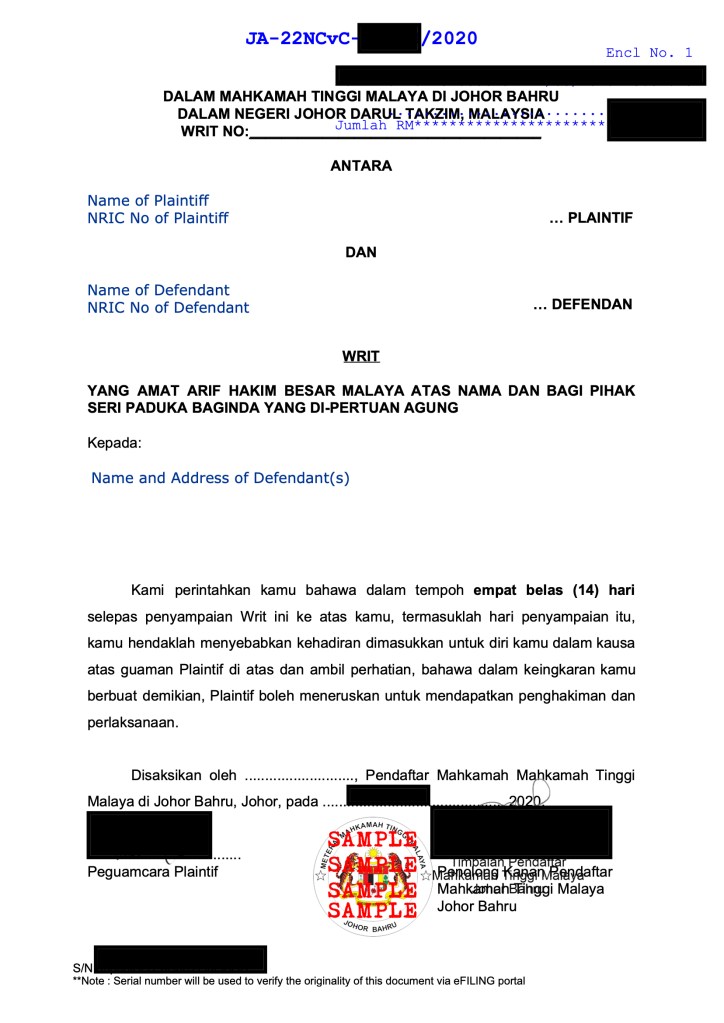
But in laymen’s term, a Writ especially in the context of civil case/claim in Malaysia, is basically a document issued by the Court directing the Defendant to attend Court because the Plaintiff has filed a claim against the Defendant. Some people also refer a Writ as “Summons” or “Saman” (in Bahasa Malaysia).
A Writ looks something like this (certain confidential informations are redacted):
What should you do after being served with a Writ?
A writ is usually served/delivered with another document known as “Statement of Claim” which list nature and grounds put forth by the Plaintiff justifying his claim. Read the Statement of Claim carefully and make notes on why you disagree with the Plaintiff’s claim together with your supporting documents. It is important that you mobilise as early as possible.
You also have to take note on the exact date when you received the Writ and Statement of Claims. This is because you only have 14 days to enter an “Appearance” against the Plaintiff’s claim.
Then what is an Appearance?
Our best friend Black’s Law Dictionary defines an “Appearance” as:
“A coming into court as a party or interested person, or as a lawyer on behalf of a party or interested person; esp., a defendant’s act of taking part in a lawsuit…”
If you still want the laymen definition, we got you covered, an Appearance is basically notice to the Court stating your intention appear and resist the Plaintiff’s claim. This is done by filing a document called Memorandum of Appearance with the Court.
What if I failed to enter Appearance withIN the stipulated deadline?
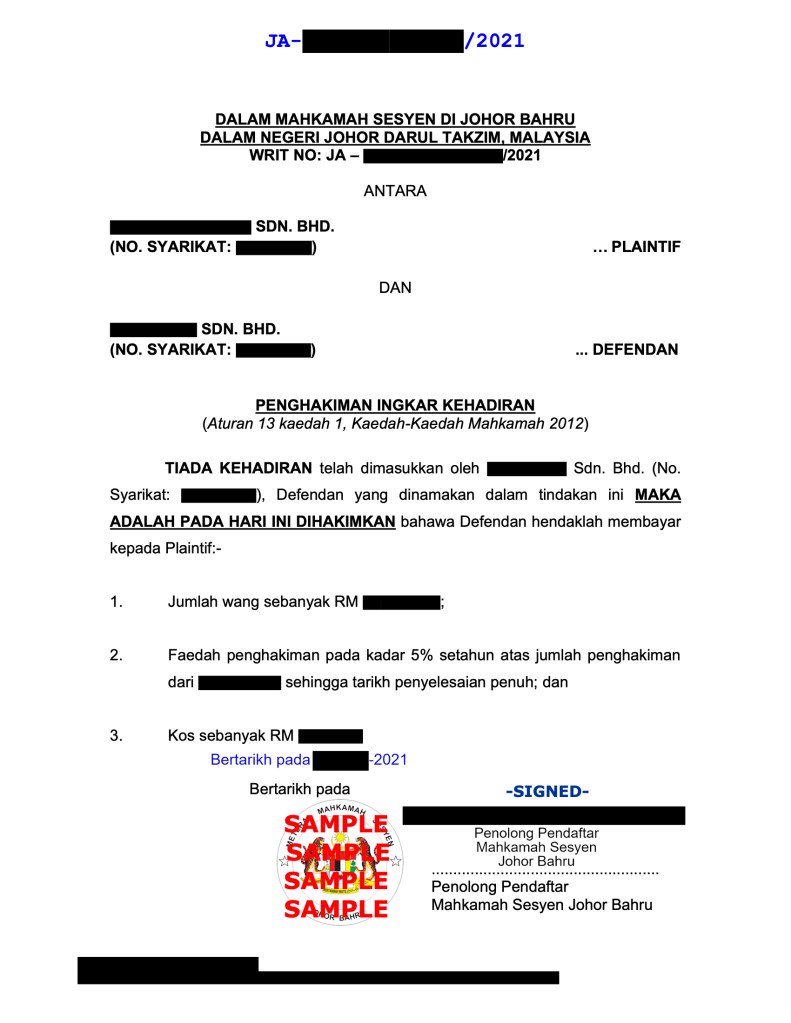
This is something you must avoid because failure to enter appearance entitled the Plaintiff to enter a Judgment in Default of Appearance against you, the Defendant (as per Order 13 of the Rules of Court 2012). Once a judgment had been obtained, it simply means that the Plaintiff has “won” the case without contest.
Order 13 Rule 1 reads:
“Where a writ is endorsed with a claim against a defendant for a liquidated demand only, then, that defendant fails to enter an appearance, the plaintiff may, after the time limited for appearing, enter final judgment against that defendant for a sum not exceeding that claimed by the writ in respect of the demand and for costs, and proceed with the action against the other defendants, if any.”
This is what a Judgment in Default of Appearance looks like (certain confidential documents are redacted):
You could always file an application to set aside the said judgment but it would only incur more costs and time. Also, there is also no guarantee that you would succeed. So, don’t take unnecessary risk and make sure you file your Appearance punctually.
As such, it is vital that you seek professional help if you intend to resist a claim so that all cause papers are duly filed and on time.
When should I start engaging a lawyer?
The soonest after you were served with the Writ since the 14 days countdown has already started. The earlier you discussed the suit with you lawyer the more time your lawyer have to prepare and strategise for your case.
In fact, you could start having a discussion with a lawyer if you expect or anticipate a possible claim.
What’s next after you have entered an Appearance?
The filing of the Appearance is really your first step into the litigation process as the Defendant in the civil suit.
Immediately after the Appearance, you are expected to file your “Defence” stating the grounds on why the Plaintiff’s claim should be dismissed by the Court and also your “Counterclaim” (if applicable)
By now you should already have appointed your own lawyer who would advise you on the next step forward. So, it is appropriate that we stop here.
End Note
This article is meant to give reader a very simplistic and general idea on the early stages of litigation from the perspective of the Defendant particularly during the short window where the Defendant has yet to appoint a lawyer.
Each cases is different and may develop quite distinctly from what we had discussed above. So, if you have received a Writ for real, you are strongly advised to seek professional legal advice rather than googling for clues online.
We hope this article is helpful, if you have questions, please do not hesitate to reach out to us. Please also follow us on Facebook and Twitter. Cheers!
