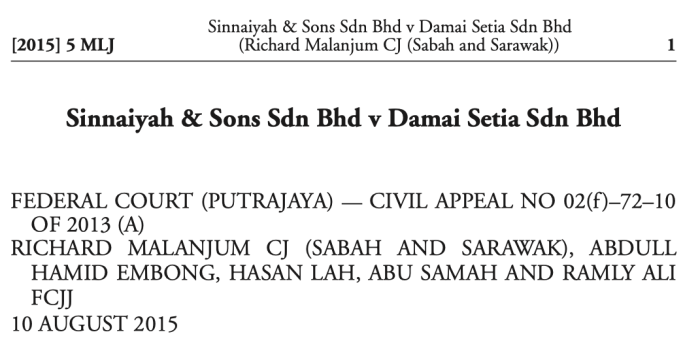
This case analysis examines the landmark Federal Court decision in Sinnaiyah & Sons Sdn Bhd v. Damai Setia Sdn Bhd [2015] 5 MLJ FC, which definitively settled a long-standing conflict in Malaysian law regarding the standard of proof required for fraud in civil proceedings.
Case Information
- Court: Federal Court (Putrajaya).
- Date of Judgment: 10 August 2015.
- Coram: Richard Malanjum CJ (Sabah and Sarawak), Abdull Hamid Embong, Hasan Lah, Abu Samah, and Ramly Ali FCJJ.
Facts of the Case
The respondent (Damai Setia) was awarded a contract by the Public Works Department (PWD) for a road-upgrading project. They appointed VN Sunrise (Sunrise) as a subcontractor and the appellant (Sinnaiyah & Sons) as the project manager. The appellant’s role was to manage the project accounts and pay subcontractors.
Disputes arose when the appellant sued for unpaid management fees and financial advances. The respondent counterclaimed, alleging that the appellant had fraudulently misappropriated monies intended for Sunrise by paying themselves instead. The appellant argued these payments were set-offs for materials supplied to Sunrise.
The Legal Issue
The Federal Court was asked to resolve whether the standard of proof for fraud in civil claims was the “balance of probabilities” or the “beyond reasonable doubt” standard. Previously, Malaysian courts were inconsistent, applying one of three standards:
- Beyond reasonable doubt (the criminal standard).
- Balance of probabilities with a requirement for a higher degree of probability depending on the seriousness of the allegation.
- A split approach where “criminal fraud” required the criminal standard while “civil fraud” required the balance of probabilities.
The Decision (Ratio Decidendi)
The Federal Court dismissed the appeal and realigned Malaysian law with other common law jurisdictions like the UK, Canada, and Australia. The court’s key findings were:
- Single Civil Standard: There are only two standards of proof in law: beyond reasonable doubt for criminal cases and the balance of probabilities for civil cases.
- No Third Standard: Even when fraud is alleged in a civil claim, the standard remains the balance of probabilities. The court explicitly rejected the idea that the “seriousness of the allegation” should change the standard of proof.
- Role of the Judge: It is up to the presiding judge to determine if the standard has been met by considering inherent probabilities as part of the evidence to decide where the truth lies.
Significance and Impact
This judgment overruled several previous Federal Court decisions, including Yong Tim v. Hoo Kok Cheong and Ang Hiok Seng @ Ang Yeok Seng v. Yim Yut Kiu, declaring them no longer good law in Malaysia.
The court clarified that this ruling applies to current and future cases but cannot be used to reopen or review past decisions that were already settled under the old standards. Because the civil standard is “less onerous” than the criminal standard used by the lower courts, the Federal Court upheld the Court of Appeal’s finding that the appellant had indeed misappropriated the funds.
Disclaimer: This post is for informational purposes only and does not constitute legal advice. Please consult a qualified lawyer for your specific legal needs.