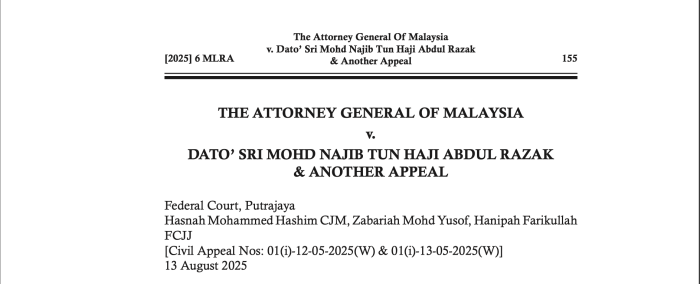
This Federal Court decision addresses pivotal questions concerning the admissibility of new evidence at the appellate stage and the legal nature of leave applications in judicial review proceedings.
1. Case Information
- Court: Federal Court, Putrajaya.
- Coram: Hasnah Mohammed Hashim CJM, Zabariah Mohd Yusof, Hanipah Farikullah FCJJ.
- Date of Judgment: 13 August 2025.
- Parties: The Attorney General of Malaysia (Appellant) v. Dato’ Sri Mohd Najib Tun Haji Abdul Razak (Respondent).
2. Facts of the Case
The Respondent, a serving prisoner, was granted a partial pardon by the Yang di-Pertuan Agong (YDPA) XVI on 29 January 2024, reducing his sentence from 12 years to 6 years and his fine from RM210 million to RM50 million. Shortly after, the Respondent claimed to have received reliable information regarding a supplementary “Addendum Order”issued by the YDPA on the same day, which purportedly directed that he serve his reduced sentence under house arrest.
Seeking to enforce this, the Respondent applied for leave for judicial review, requesting a mandamus order to compel the authorities to confirm the existence of the Addendum Order and provide a copy thereof. The High Court dismissed the application, prompting an appeal to the Court of Appeal. Two days before the appellate hearing, the Respondent moved to introduce the actual Addendum Order as new evidence. The Court of Appeal (Majority) allowed the evidence and granted leave for the judicial review to proceed.
3. Legal Issues
The Federal Court was tasked with determining:
- Whether an application for leave for judicial review is interlocutory in nature (affecting whether new evidence requires leave under Rule 7 of the RCA 1994).
- Whether the principles established in Ladd v. Marshall were codified or merely reflected in Rule 7(3A) of the RCA 1994.
- Whether the “determining influence” threshold in Rule 7(3A) is stricter than the “important influence” threshold in Ladd v. Marshall.
4. The Decision (Ratio Decidendi)
The Federal Court dismissed the Attorney General’s appeals, establishing several key principles:
- Finality of Leave Applications: The Court ruled that an application for leave in judicial review is not an interlocutory proceeding because a refusal of leave determines the rights of the parties with finality. Therefore, leave of the court is required to introduce new evidence that existed prior to the original decision.
- Encapsulation of Ladd v. Marshall: The Court held that Rule 7(3A) of the RCA 1994 encapsulates the essential features of the Ladd v. Marshall test. The criteria should be treated as flexible guidelines adapted to the interests of justice rather than rigid statutory provisions.
- Threshold of Influence: The Court concluded that, practically speaking, there is no meaningful consequence between the “important influence” and “determining influence” standards at the appellate level.
- AG’s Concession: Crucially, during the Federal Court hearing, the Attorney General conceded that the Addendum Order exists.
5. Key Court Excerpts
On the nature of leave for judicial review: “The application for leave in the Judicial Review proceedings is not an interlocutory proceeding for the purpose of r 7(2) of the RCA 1994, and hence leave is required. Therefore, although the application… is interlocutory in form, it is an application to decide on the rights of the parties, hence as regards evidence it ought not be regarded as an interlocutory proceeding”.
On Rule 7(3A) and Ladd v. Marshall: “While the Ladd v. Marshall conditions remain apposite, they should not be construed as strictly as though they have statutory or legislative force, but rather, they should be treated as a set of guidelines to be adapted as the interests of justice may require… The Ladd v. Marshall criteria serve as a useful interpretive tool”.
On the Addendum Order’s admissibility: “Apart from the relentless and repeated attempts to obtain the Addendum Order by the respondent, the issue of the sensitive nature of the Addendum Order and strict protocol involving the Palace… the respondent had also satisfied the conditions”.
6. Conclusion
The Federal Court affirmed that the Respondent exercised reasonable diligence in attempting to obtain the document, which was restricted by Royal protocol until December 2024. By allowing the Addendum Order into evidence and upholding the grant of leave, the Court ensured that the substantive validity and effect of the YDPA’s supplementary order could be properly adjudicated at a full hearing in the High Court.
7. High Court dismissed the Respondent’s application for judicial review
On December 24, 2025, the High Court dismissed former Prime Minister Najib Razak’s application for a judicial review to serve his sentence under house arrest, ruling that the royal “addendum order” he relied upon was invalid because it was issued outside of the constitutional framework. Justice Alice Loke clarified that while the existence of the order was undisputed, the Yang di-Pertuan Agong’s (YDPA) powers of clemency are strictly limited by Article 42 of the Federal Constitution, which mandates that the monarch must act on the advice of the Pardons Board. The court found that because the order did not follow mandatory procedural requirements—specifically that Pardons Board meetings must be held in the presence of the YDPA—it was legally ineffective. As a result, Najib remains in Kajang Prison to complete his reduced six-year sentence for the SRC International case, although his legal team intends to appeal the decision.
The High Court decision could still subject to further appeal.
Disclaimer: This post is for informational purposes only and does not constitute legal advice. Please consult a qualified lawyer for your specific legal needs.