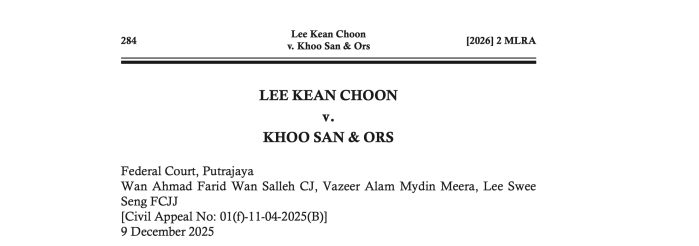
This case analysis of Lee Kean Choon v. Khoo San & Ors [2026] 2 MLRA 284 FC examines a significant Federal Court decision regarding the statutory requirements for communicating administrative land decisions and the protection of co-proprietors’ rights under the National Land Code (NLC).
Case Information
- Case: Lee Kean Choon v. Khoo San & Ors [2026] 2 MLRA 284.
- Court: Federal Court, Putrajaya.
- Judges: Wan Ahmad Farid Wan Salleh CJ, Vazeer Alam Mydin Meera, Lee Swee Seng FCJJ.
- Decision Date: 9 December 2025.
Summary of Facts
The appellant and the 1st respondent were co-proprietors of two plots of land (Geran 326882 and 326883) with equal undivided shares. Their relationship was governed by a 1971 Agreement between the 1st respondent and the appellant’s father, which divided the land into specific portions: the appellant cultivated durian trees on his section, while the 1st respondent grew oil palm trees on his.
In February 2020, the 1st respondent applied for a partition of the land under s 141A of the NLC without the appellant’s knowledge or consent. The 2nd and 3rd respondents (Land Office authorities) approved the partition based on a plan that ignored the 1971 Agreement. This resulted in an unequal distribution where half of the appellant’s durian trees were moved to the 1st respondent’s new title.
The appellant only learned of the partition in March 2021 when a surveyor on the land showed him an approval letter. He eventually obtained the official documents on 18 August 2021 and filed an appeal under s 418 of the NLC on 3 November 2021. Lower courts dismissed his appeal as “out of time,” arguing the three-month limit began when he spoke to the surveyor in March 2021.
Key Legal Issues
- Meaning of “Communicated”: Does the phrase “communicated to him” in s 418 of the NLC require an official letter from the Land Office to trigger the three-month appeal period?
- Validity of the Partition: Was the partition valid despite the 1st respondent’s failure to disclose the 1971 Agreement and the Land Office’s failure to properly serve notice to the appellant?
Holding and Decision
The Federal Court allowed the appeal, setting aside the decisions of the High Court and Court of Appeal. The court cancelled the new titles and ordered the reinstatement of the original land titles.
Legal Reasoning
1. Clarification of Statutory Communication (The Leave Question)
The Court held that for the purposes of s 418 of the NLC, a decision is only “communicated” when the affected party is served with an official written notice under the hand of the authority.
- A casual encounter with a surveyor does not constitute “actual knowledge” or “communication”.
- The three-month timeline for the appeal began on 18 August 2021 (the date the appellant received official documents), making the November 2021 filing timely.
2. Breach of Natural Justice and Statutory Duty
The Court identified a “fatal flaw” in the Land Office’s procedure:
- Mandatory Notice: Under s 142(3) of the NLC, the Land Administrator has a legal duty to notify co-proprietors of a partition application. Failure to do so deprived the appellant of his statutory right to object.
- Substituted Service: The Court of Appeal had previously found that the Land Office’s attempt at substituted service was “irregular and premature”.
3. Failure of Full and Frank Disclosure
The 1st respondent had a duty to disclose all relevant matters when applying for partition. By suppressing the 1971 Agreement, he misled the 2nd respondent, who made a decision without knowing that the proposed partition would cause “injustice and harm” by splitting the appellant’s durian grove.
Significance
This ruling reinforces the principle that administrative decisions are not operative until proper notice is given to the affected person. It prevents public authorities from relying on “straws”—such as informal verbal information—to justify a failure to perform statutory duties. Furthermore, it affirms that co-proprietors must act in good faith and disclose existing contractual agreements when seeking to alter land titles.
Disclaimer: This post is for informational purposes only and does not constitute legal advice. Please consult a qualified Advocates & Solicitors for your specific legal needs.