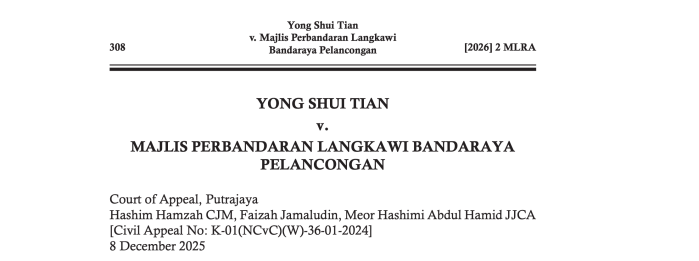
This case analysis examines the Court of Appeal decision in Yong Shui Tian v. Majlis Perbandaran Langkawi Bandaraya Pelancongan [2026] 2 MLRA 308 CA, which clarifies the extensive statutory duties of local authorities regarding public safety and tree maintenance.
Case Information
- Case: Yong Shui Tian v. Majlis Perbandaran Langkawi Bandaraya Pelancongan 2 MLRA 308.
- Court: Court of Appeal, Putrajaya.
- Judges: Hashim Hamzah CJM, Faizah Jamaludin, Meor Hashimi Abdul Hamid JJCA.
- Decision Date: 8 December 2025.
Summary of Facts
On 9 January 2019, the appellant, a tourist at Pantai Chenang beach in Langkawi, suffered a broken back and permanent paralysis of his lower body when a coconut tree unexpectedly fell on him. Another victim tragically lost his life in the same incident. The appellant filed a claim against the respondent, the local authority for Langkawi, alleging negligence and breach of statutory duty under the Local Government Act 1976 (LGA 1976).
The respondent denied liability, arguing that the beach was private or state land outside their jurisdiction, and that the tree fell due to an “Act of God” (strong winds). The High Court initially dismissed the claim, leading to this appeal.
Key Legal Issues
- Jurisdiction: Did Pantai Chenang beach fall within the respondent’s administrative area?
- Statutory Duty: Does Section 101 of the LGA 1976 impose a mandatory duty on local authorities to maintain trees, even those on private land?
- Breach and Evidence: Did the respondent breach its duty, and were the weather conditions truly an “Act of God”?
- Res Ipsa Loquitur: Could negligence be inferred if the exact cause of the tree falling was known?
Holding and Decision
The Court of Appeal allowed the appeal, setting aside the High Court’s judgment. The court found the respondent wholly liable for the injuries and remitted the case to the High Court for the assessment of damages.
Legal Reasoning
1. The Scope of Local Authority Jurisdiction
The Court held that the Kedah Government Gazette unequivocally declared the entire administrative district of Langkawi as a local authority area. Consequently, Pantai Chenang beach falls under the respondent’s jurisdiction regardless of whether the specific plot of land is privately owned or state-owned. Furthermore, the court determined that a beach qualifies as a “public place” and a “street” under the definitions provided in Section 2 of the LGA 1976.
2. Mandatory Statutory Duties under Section 101
Following Federal Court precedent, the Court emphasized that Section 101 of the LGA 1976 is worded in imperative terms. The local authority has a statutory obligation to:
- Trim or remove trees that pose a potential threat to public safety.
- Manage and supervise open spaces and holiday sites.
- Enter private property if necessary to remove or prune hazardous trees.
3. Admission of Non-Performance
The respondent’s own witnesses admitted during the trial that the authority did not monitor, maintain, or trim coconut trees on the beach, focusing exclusively on trees along main roads. Under the law, a breach of statutory duty is established simply by showing the non-performance of the mandated act.
4. Rejection of “Act of God” and Contributory Negligence
The Court found the High Court’s finding of “strong winds” to be plainly wrong. Meteorological data showed wind speeds of only 3 meters per second (weak/mild) at the time of the incident. Therefore, the weather did not constitute an Act of God, and the appellant was not negligent for being on the beach.
5. Doctrine of Res Ipsa Loquitur
The Court ruled that the appellant did not need to rely on this doctrine because the exact cause of injury (the falling tree) and the specific failure (lack of maintenance) were already clearly established.
Significance
This ruling reinforces that a local authority’s duty to ensure public safety is comprehensive and non-discretionarywithin its entire gazetted area. It confirms that authorities cannot escape liability for hazardous trees by claiming the land is private, especially in areas where the public has a right of way.
Disclaimer: This post is for informational purposes only and does not constitute legal advice. Please consult a qualified Advocate & Solicitor for your specific legal needs.