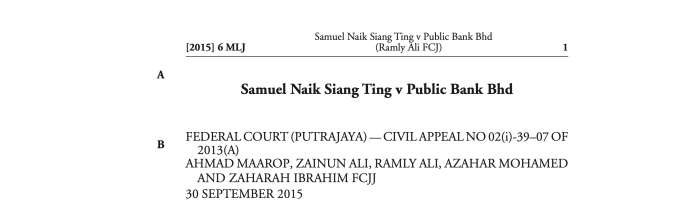
The case of Samuel Naik Siang Ting v. Public Bank Bhd [2015] 6 MLJ 1 FC is a landmark Federal Court decision that clarifies the intersection between the Torrens system of land registration and equitable interests in Malaysia. It specifically addresses the vulnerability of an immediate registered purchaser when their title is obtained through a void instrument.
1. Case Information
- Court: Federal Court of Malaysia (Putrajaya).
- Parties: Samuel Naik Siang Ting (Appellant/New Purchaser) and Public Bank Bhd (Respondent/Lender).
- Core Question: Whether the title of a bona fide registered owner without notice can be defeated by the non-registered equitable interest of an absolute assignee/lender under an earlier sale and purchase agreement (SPA) for the same land.
2. Facts of the Case
The Majlis Perbandaran Manjung (MPM) was the registered proprietor of land that Bersatu Maju Properties (BMP) was developing. MPM and BMP sold several lots to “earlier purchasers” between 2001 and 2002. Public Bank financed these purchases. Because individual titles had not yet been issued, the bank secured the loans via Deeds of Assignment, where the purchasers assigned all rights and interests in the lots to the bank. MPM and BMP also provided letters of undertaking to deliver the titles to the bank once issued.
The bank disbursed the full purchase price to the developer by February 2003. However, when titles were issued in June 2003, MPM and BMP did not notify the bank. Instead, they sold the same lots to “new purchasers,” including the appellant, Samuel Naik. These new purchasers eventually registered the titles in their own names. Upon discovering this, the bank lodged caveats and sued to declare the second set of sales void.
3. Key Legal Issues and Findings
The Status of the Bank as Equitable Mortgagee
The Federal Court affirmed that the Deeds of Assignment were not just “charges” but equitable mortgages. Even though the National Land Code (NLC) does not explicitly use the word “mortgage,” the court must give effect to ordinary commercial transactions where land is assigned as security for a loan.
The Bare Trustee Doctrine
The court held that once MPM (the vendor) received the full purchase price from the earlier purchasers, it became a bare trustee. As a bare trustee, MPM had no beneficial interest left in the land and no legal capacity to sell it to a second set of purchasers.
Void Instruments and Indefeasibility
The appellant argued his title was indefeasible under Section 340 of the NLC as a bona fide purchaser for value. However:
- Void Instrument: Because MPM had no capacity to sell the land twice, the second SPA and the subsequent transfer forms (Form 14A) were void instruments.
- Deferred Indefeasibility: Following the landmark Tan Ying Hong case, the court ruled that Malaysia practices deferred indefeasibility. This means the protection for bona fide purchasers under the proviso of Section 340(3) applies only to subsequent purchasers, not immediate purchasers.
- Application: Since Samuel Naik purchased the land directly from the bare trustee (MPM), he was an immediate purchaser. Because his registration was obtained via a void instrument, his title was defeasible (could be set aside), regardless of his good faith.
Failure to Lodge a Caveat
The appellant contended the bank lost its priority by failing to lodge a caveat timeously. The court rejected this, stating that a caveat is merely a “warning” and does not create new rights. The bank’s failure to caveat did not negate its existing equitable interest.
Unpleaded Issues
During the appeal, the appellant’s counsel attempted to raise a new issue regarding the original ownership of the land. The Federal Court refused to consider it, emphasizing that parties are bound by their pleadings. Allowing a “last minute” issue that completely changes the defense would be a denial of justice to the respondent.
4. Conclusion
The Federal Court dismissed the appeal, answering the leave question in the affirmative. It concluded that the valid equitable interest of an absolute assignee (the Bank) from an earlier sale prevails over the registered title of a bona fide immediate purchaser whose registration was based on a void instrument.
Disclaimer: This post is for informational purposes only and does not constitute legal advice. Please consult a qualified Advocate & Solicitor for your specific legal needs.